


Dr. Chirag Jain Presents HRV-Guided Cancer Anxiety Research at ISOCON 2026
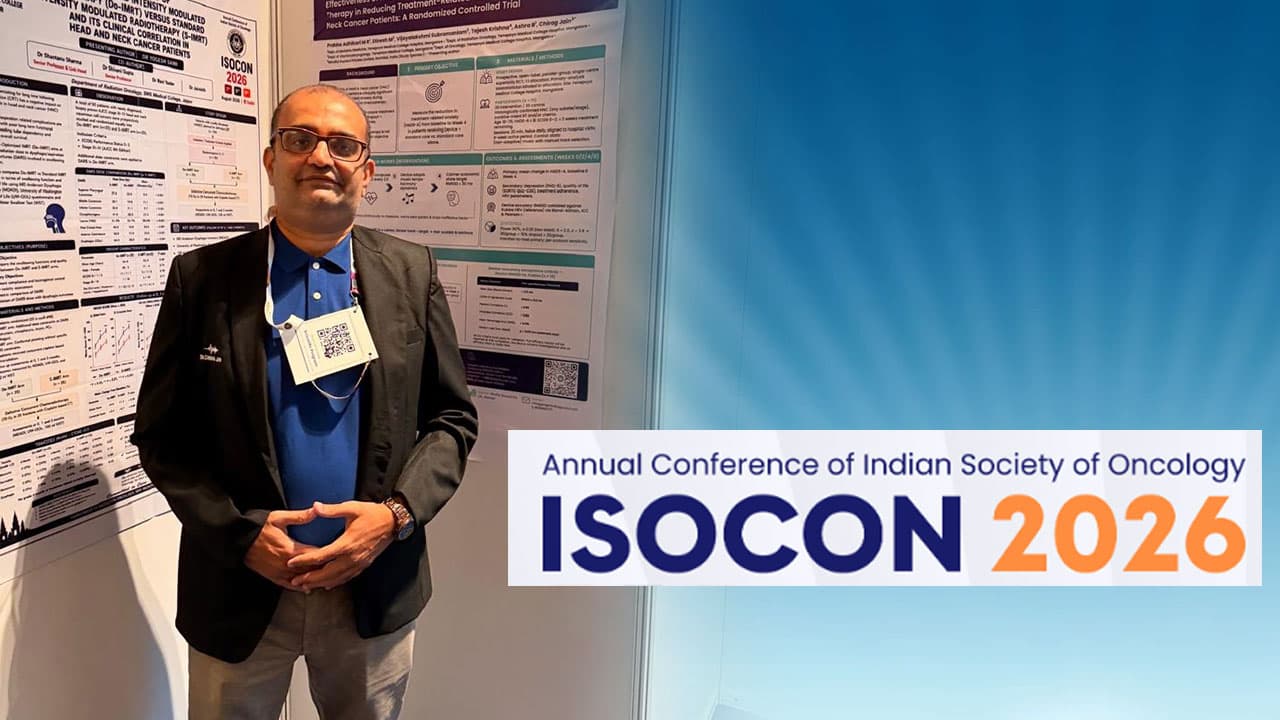
Dr. Chirag B. Jain participated in ISOCON 2026, held in Faridabad from 7th to 9th August, 2026 under the aegis of the Indian Society of Oncology. The conference, themed “Precision Oncology with Collaboration,” brought together oncology professionals to discuss emerging approaches in cancer care and research.
At the conference, Dr. Jain presented a scientific poster as the presenting author of an ongoing randomized controlled trial investigating treatment-related distress in patients with head and neck cancer. The research focuses on real-time heart-rate-variability-guided adaptive music therapy as an intervention during cancer treatment.
The study is currently ongoing, and the presentation represents the research methodology and investigation rather than completed clinical outcomes.
ISOCON 2026: Dr. Jain's Research at a Glance
Research element | Details |
Conference | ISOCON 2026 |
Location | Faridabad |
Research focus | Treatment-related distress in head and neck cancer |
Study design | Prospective randomized controlled trial |
Study population | 70 head and neck cancer patients |
Intervention group | 35 patients |
Comparison group | 35 patients |
Primary clinical measure | HADS-A |
Physiological measure | HRV, including RMSSD |
Intervention | Real-time HRV-guided adaptive music therapy |
Study centre | Yenepoya Medical College Hospital, Mangalore |
Study sponsor | Mindful Gurukul Pvt. Ltd., Mumbai |
The Research Presented at ISOCON 2026
The scientific poster was titled:
“Effectiveness of Real-Time HRV-Guided Adaptive Music Therapy in Reducing Treatment-Related Distress in Head & Neck Cancer Patients: A Randomized Controlled Trial.”
The prospective randomized controlled trial includes 70 patients.
Participants are divided equally between two groups.
Intervention group
35 patients receive adaptive music therapy.
Standard cancer care continues alongside the intervention.
Physiological responses are monitored during the intervention.
Music characteristics can change according to the physiological response.
Comparison group
35 patients receive standard care.
Participants receive static or non-adaptive music.
The comparison allows the adaptive component to be evaluated.
This design allows the researchers to compare two approaches systematically.
It also allows clinical and physiological outcomes to be examined together.
What Is the Trial Evaluating?
The primary clinical endpoint is anxiety, assessed using the Hospital Anxiety and Depression Scale-Anxiety (HADS-A) subscale. The primary comparison examines the change in anxiety scores from baseline to Week 4. The trial also evaluates several secondary outcomes to assess additional effects of the intervention, including other clinical and patient-related measures.
Secondary measures include:
Depression
Quality of life
Treatment adherence
Heart-rate-variability parameters
Physiological response during intervention sessions
This multidimensional approach combines patient-reported and physiological measures.
It therefore extends assessment beyond questionnaire responses alone.
How the HRV-Guided Intervention Works
The intervention follows a closed-loop model in which music is continuously adapted based on the patient’s physiological response rather than delivered as a fixed track.
During each session, the patient wears a Polar H10 chest sensor that monitors heart-rate variability (HRV). The system repeatedly assesses HRV, including RMSSD as one of the parameters being evaluated.
These physiological measurements can then inform changes in the music, creating a continuous cycle of physiological response, music adaptation, and further physiological assessment.
The process can be represented as:
Patient → Polar H10 sensor → HRV measurement → RMSSD assessment → Music adaptation → Physiological response → Further adaptation
These changes may involve:
Tempo
Harmony
Dynamics
The intervention is designed to respond to the patient's changing physiological state.
The researchers are investigating whether this closed-loop approach can help reduce treatment-related distress.
Why This Research Uses HRV
Heart-rate variability provides a physiological measure related to autonomic regulation. It can complement conventional psychological assessment. The trial therefore examines anxiety through two connected perspectives.
Psychological assessment
HADS-A captures the patient's reported anxiety symptoms.
Physiological assessment
HRV parameters provide physiological measurements during the intervention.
This combination allows the research team to examine whether subjective and physiological responses change together.
The study does not assume that HRV can replace psychological assessment.
Instead, it investigates whether physiological monitoring can provide complementary information.
From Static Music to Adaptive Intervention
Unlike conventional music interventions that rely on predetermined content, the approach being investigated in Dr. Jain's research is dynamically responsive to physiological feedback, allowing music characteristics to change in real time during the session. This establishes a closed feedback loop between physiological monitoring and the intervention, with the core research question focusing on whether this adaptive method produces measurable clinical differences.
While an ongoing clinical trial aims to provide the necessary evidence to evaluate this, no definitive efficacy conclusions are being drawn until the study is fully completed.
The Wider Question: Anxiety Across the Cancer Journey
Dr. Jain's ISOCON participation also involved discussions around Onco-Anxiology. His work proposes a more focused approach to anxiety during cancer care. A recently published Perspective by Dr. Jain describes Onco-Anxiology as a proposed longitudinal framework within psycho-oncology.
The framework focuses on three principles:
Anxiety-specific clinical attention
Longitudinal assessment
Cancer-specific anxiety mechanisms
The approach considers anxiety across different stages of cancer care.
These stages can include:
Diagnosis → Treatment initiation → Active treatment → Follow-up → Surveillance
Anxiety may not remain constant across these stages. Its clinical presentation can also overlap with treatment-related symptoms. This creates important questions for clinical assessment.
Questions Discussed With Oncology Professionals
The scientific discussions at ISOCON extended beyond whether anxiety occurs in cancer. They considered how anxiety could be identified and followed during treatment.
Key questions included:
Should anxiety be assessed longitudinally?
Repeated assessment may provide information that a single assessment cannot capture.
How does anxiety change during treatment?
Symptoms may change around diagnosis, treatment initiation, chemotherapy, radiotherapy, follow-up, and surveillance.
Can physiological measurements complement psychological screening?
HRV may provide additional physiological information alongside validated psychological measures.
Can anxiety assessment fit into oncology workflows?
Any future approach would need to remain practical for oncology teams.
How should anxiety be distinguished from treatment effects?
Anxiety-related symptoms may overlap with symptoms caused by treatment, medication, or disease progression.
Can earlier identification support better care?
This remains an important research question within anxiety-focused oncology care.
These questions help move the discussion toward longitudinal and clinically relevant assessment.
Onco-Anxiology: From Concept to Research
Dr. Chirag Jain’s recent scientific work introduces Onco-Anxiology as a focused framework within the broader field of psycho-oncology. Rather than presenting itself as an established medical specialty, the concept is offered as a testable clinical and research framework designed to examine anxiety across the entire cancer continuum.
This framework specifically targets the unique psychological challenges faced by patients by recognizing cancer-specific mechanisms of anxiety, such as intense anticipatory anxiety and the fear surrounding future cancer events. Furthermore, it accounts for the complex overlap between psychological anxiety symptoms and the physical side effects of cancer treatments, ensuring a more nuanced understanding of patient distress.
By clearly mapping these unique intersections, Onco-Anxiology establishes a strong foundation for developing targeted, hypothesis-driven research questions. The ongoing HRV-guided music therapy trial serves as a prime example of this direction in action, translating the framework's theoretical principles into an empirical investigation of adaptive clinical interventions.
Connecting Clinical Research With Physiological Data
A central feature of Dr. Jain's research is the integration of psychological and physiological assessment.
The current trial brings together:
Clinical dimension | Research measure |
Anxiety | HADS-A |
Depression | Psychological assessment |
Quality of life | Patient-reported assessment |
Treatment experience | Treatment adherence |
Autonomic response | HRV parameters |
Real-time physiological response | RMSSD monitoring |
This structure allows multiple dimensions of treatment-related distress to be studied. It also creates an opportunity to examine physiological responses during an intervention. The researchers will determine whether these measures demonstrate meaningful changes.
Why the ISOCON Presentation Matters
ISOCON 2026 provided a scientific platform for presenting the ongoing research.
The conference emphasizes research presentations, multidisciplinary learning, and collaboration in oncology.
Dr. Jain's participation placed his research within this professional oncology environment.
The presentation also enabled discussion with oncology professionals from different institutions.
These interactions focused on the practical assessment of anxiety during cancer care.
They also explored how physiological monitoring could complement existing approaches.
The discussions helped broaden the conversation from psychological symptoms alone.
They focused instead on timing, measurement, clinical integration, and longitudinal care.
A Meeting of Clinical Perspectives
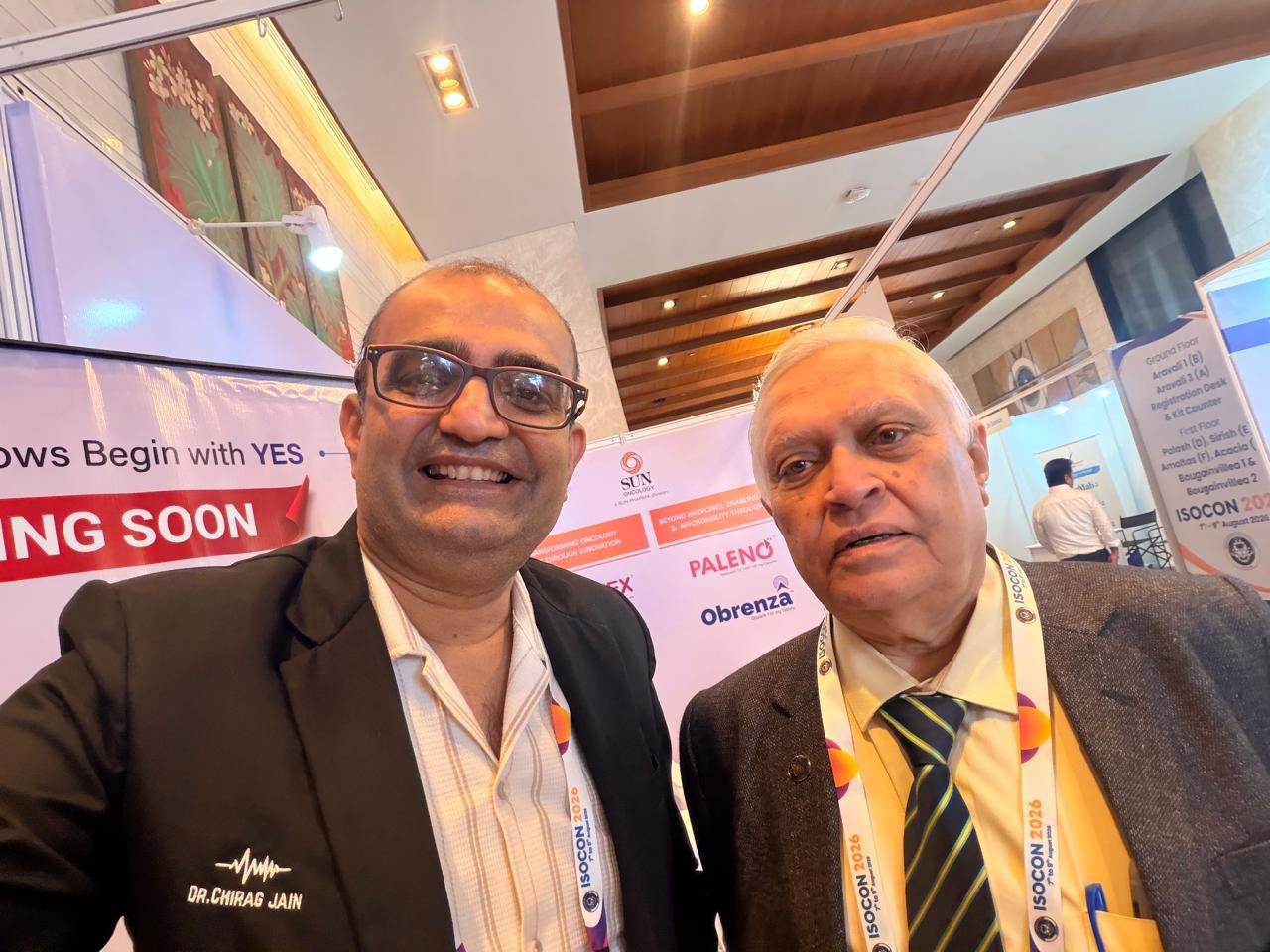
Dr. Chirag B. Jain with Dr. P.S. Gopinath at ISOCON 2026, during a professional and academic interaction at the conference.
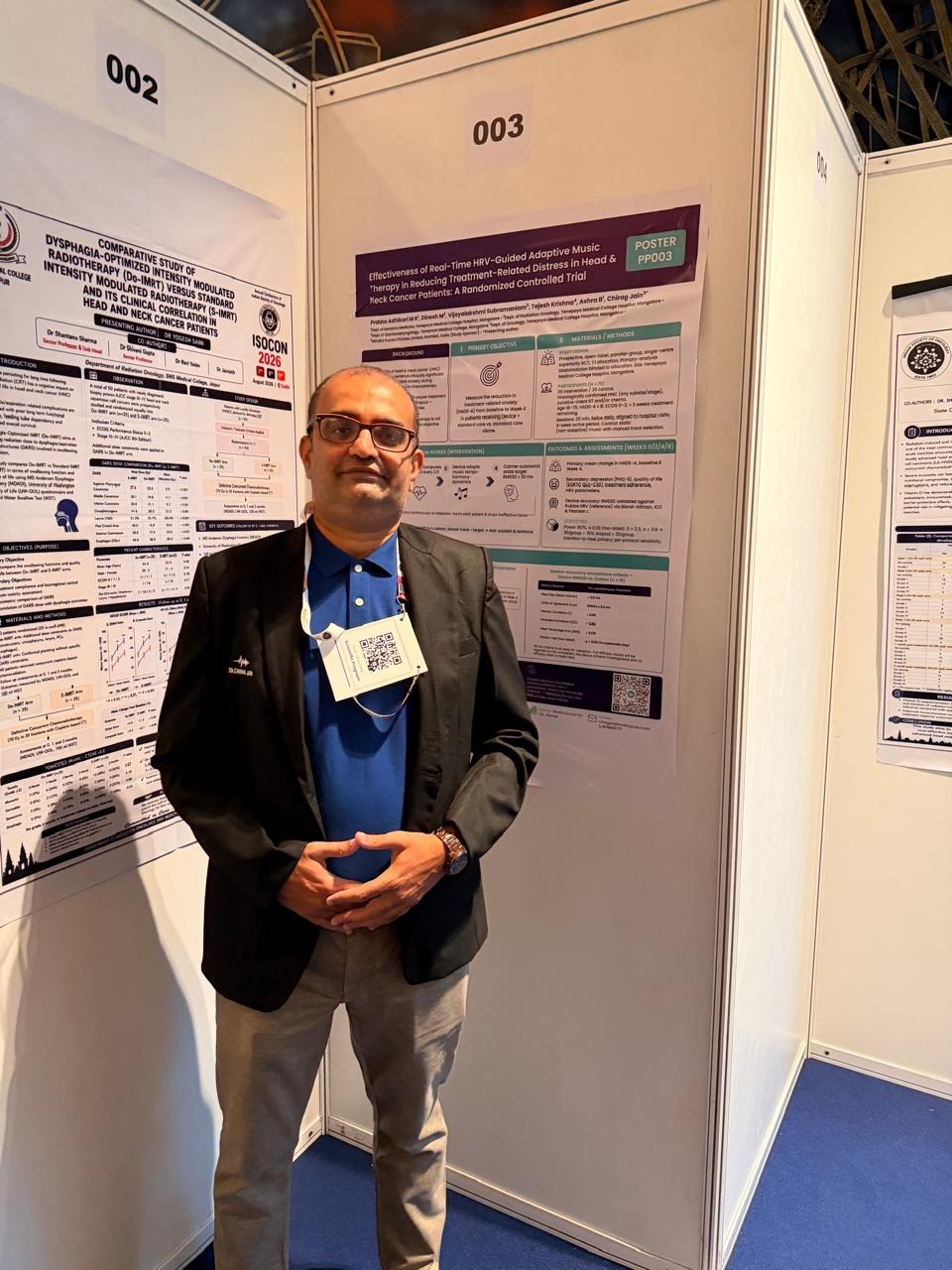
Dr. Jain with his research poster
Research That Remains Focused on Evidence
Because the current trial is still ongoing, its findings should not be interpreted or generalized before the study is officially completed.
The investigation is centered on a rigorous framework designed to evaluate the impact of real-time interventions:
Core Research Focus: Assessing whether real-time, HRV-guided adaptive music therapy effectively reduces treatment-related distress.
Methodology: Utilizing predefined clinical and physiological measures to track patient responses objectively.
Comparative Design: Incorporating a control group that receives static or non-adaptive music to ensure a structured basis for evaluation.
Ultimately, the final results will determine whether the observed changes provide robust support for the research hypothesis. Until that data is available, the appropriate focus remains on the foundational research question and the study design itself.
Looking Ahead
Dr. Jain's participation at ISOCON 2026 marks a key step in his research program. His work unites psycho-oncology, physiological monitoring, and non-pharmacological therapies. A randomized trial tests these ideas within a structured clinical setting. The Onco-Anxiology framework offers a broader context for these efforts. Ultimately, the work asks critical questions about when and how anxiety emerges during cancer care. The trial's completion remains the next vital milestone for generating clear evidence.